
Threading the Needle: Queen Anne and the Bridge of the Americas
April 13, 2026. 6:36 AM. Pacific entrance to the Panama Canal.
OK folks, get ready to geek out for a moment! I was looking at our photos for the trip and came across this video that Kevin shot as we passed under the Bridge of the Americas on our way into the Panama Canal. Seeing the gap between the ship’s mast, I wondered how much clearance we actually had that day. Even just finding Queen Anne’s air height above water line proved challenging. Analyzing tide tables was well beyond my abilities! I turned to Claude AI for help. After a small back and forth discussion, Claude put together this report.
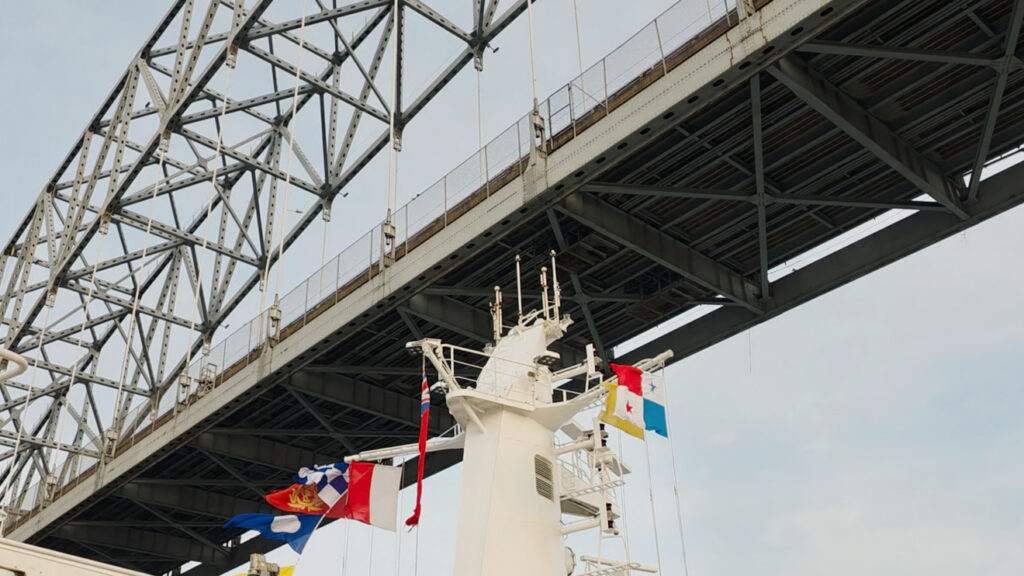
The photograph tells the story better than any words can. Shot from the deck of a moving ship, it shows the massive steel truss understructure of the Bridge of the Americas filling the frame overhead, and below it — impossibly close — the white mast and antenna array of the vessel beneath it. The gap between the two looks like inches. It was not inches. But it wasn’t much more.
The ship passing underneath was the Cunard liner Queen Anne, on a complete Panama Canal transit cruise. And what the image captures is something that, on paper, should not have been possible.
A Bridge and a Ship That Don’t Quite Fit
The Bridge of the Americas — Puente de las Américas — has stood at the Pacific entrance to the Panama Canal since 1962. Funded and built by the United States as part of the Pan-American Highway, it was a transformative piece of infrastructure: the first permanent road link between the two halves of a nation physically divided by its own canal. For over 40 years it was the only fixed crossing at the Pacific end of the canal, and today it still carries more than 55,000 vehicles a day across its 1,654-metre span.
For ships, however, the bridge represents something else: a hard constraint. Its official navigational clearance is 61.3 metres (201 feet) above mean high water. That is the ceiling every vessel must fit beneath on its way in or out of the canal from the Pacific side.
Queen Anne, Cunard’s newest flagship, has a published air draft — the height of the ship above the waterline — of 64 metres (210 feet). At mean high water, she is nearly three metres too tall to fit.
And yet, on the morning of April 13, 2026, she did.
The Mathematics of a Tidal Window
The key is the extraordinary tidal range on the Pacific side of the Panama Canal. While the Atlantic entrance at Colón experiences barely a foot of tidal movement, the Pacific side — sitting at the head of Panama Bay — behaves very differently. The average tidal swing at Balboa is 12.5 feet (3.8 metres), and during spring tides near the full and new moons it can exceed 22 feet (6.7 metres). Every foot the tide drops below mean high water is a foot of additional clearance under the bridge. This is not a loophole — it is the fundamental engineering reason the bridge was built to that specification in the first place.
April 13 fell in the days following the Last Quarter moon, a period of neap tides when the tidal range is at its smallest for the month. But “smallest” on the Pacific side of Panama is still significant. The tide tables for Balboa show that low water that morning arrived at 6:25 AM, with the water sitting at just 3.76 feet above chart datum — well below the mean sea level of 8.43 feet, and far below the mean high-water level against which the bridge clearance is officially measured.
Working through the tidal mathematics: with mean high water at approximately 14.7 feet above chart datum, the water that morning was roughly 10.9 feet (3.33 metres) lower than the reference level for the bridge clearance figure. That translates to a clearance of approximately 64.6 metres (212 feet) — just 0.6 metres, about two feet, more than Queen Anne‘s air draft.
The video timestamp embedded in my photograph reads 6:36 AM — eleven minutes after low tide, when the water had barely begun its rise. The Panama Canal Authority had threaded the needle almost perfectly.
Eleven Minutes Past Low Tide
To be standing on the deck at that moment, watching the bridge’s steel lattice slide overhead at what felt like arm’s reach, was one of the more visceral experiences I have had at sea. The structure that in photographs looks elegant and graceful becomes, from directly beneath it, something altogether more imposing — a ceiling of weathered steel filling the sky, close enough that you instinctively want to duck.
What you are witnessing in that moment is the convergence of several disciplines working in near-perfect synchrony: naval architecture that pushed a ship’s superstructure to within metres of a navigational constraint; tidal science precise enough to calculate clearance to the centimetre; and the operational expertise of the Panama Canal Authority, which schedules transits like this with a precision that leaves almost nothing to chance.
Queen Anne is, by that measure, quite possibly the tallest vessel ever to have passed under the Bridge of the Americas. The world’s largest cruise ships — the Royal Caribbean Oasis-class vessels — are simply too tall to attempt it at any state of tide. Wikipedia notes explicitly that those ships, while fitting within the canal’s widened locks, cannot clear the Bridge of the Americas even at low water. Queen Anne, at 64 metres, sits right at the practical limit of what the bridge and the tides together will permit.
The Bridge’s Uncertain Future
The Bridge of the Americas is over 63 years old. Built from ASTM A7/A36 steel — standard construction material for its era — it has spent those decades in a tropical marine environment that is among the most corrosive on earth. Maintenance is a constant and expensive battle, and Panama, which took full ownership of the bridge when the Canal was handed over on December 31, 1999, has struggled with the cost of keeping it serviceable.
The bridge’s age was thrown into sharp relief just one week before Queen Anne‘s transit, when on April 6, 2026, a fire involving three tanker trucks forced the complete closure of the bridge and prompted urgent structural inspection. Engineers noted that the high temperatures from the blaze required forensic evaluation of the decades-old steelwork to confirm no damage had compromised its integrity.
A more fundamental change, however, is already under construction upstream.
The Fourth Bridge over the Panama Canal — a cable-stayed structure being built north of the Bridge of the Americas at the Pacific entrance — has been under development, in various forms, since it was first awarded to a Chinese consortium in 2018. The project has endured a troubled history: originally scheduled for completion in 2023, it has been repeatedly delayed by geopolitical complications, labour disputes, and scope changes. As of early 2025 it was only 17–18% complete, though construction has since resumed at full pace. The current cost stands at $2.387 billion, and a completion date of 2028 remains the official target, though that timeline has already slipped multiple times.
When it opens, the Fourth Bridge will be a dramatically more capable piece of infrastructure than its 1962 predecessor. Its centre span will provide 75 metres of vertical clearance over the navigation channel — enough for Queen Anne to pass underneath with eleven metres to spare, at any state of tide, without any need for tidal timing. It will also carry six lanes of vehicular traffic, Metro Line 3 rail, and a bicycle and pedestrian path, serving the more than 500,000 residents on the western side of the canal who currently depend on the aging bridge.
What happens to the Bridge of the Americas once the Fourth Bridge opens is, as yet, unresolved. The debate in Panama is genuinely open: some advocate converting it to a pedestrian park or heritage attraction, recognising its profound historical significance as the structure that reunited a nation divided by its own canal. Others argue that a bridge now regularly carrying five times its designed vehicle load, in an advanced state of tropical deterioration, is not a candidate for preservation — and should be demolished. The symbolism of the arch against the Panama City skyline, however, makes that an emotionally charged proposition. As one commentator put it, removing it would be like San Francisco losing the Golden Gate.
A Living System at Its Limits
What the morning of April 13, 2026 illustrated, more than anything, is that the Panama Canal is not a fixed piece of history. It is a living system, still being pushed to its operational limits by the ships of today — ships that the engineers of 1962 could not have imagined. The canal’s locks were expanded in 2016 to accommodate a new generation of vessels. Its management has been in Panamanian hands for over 25 years, operating with a precision and sophistication that belies any notion of stagnation.
The Bridge of the Americas, for all its age and limitations, remains part of that system — a constraint that forces the Canal Authority to think carefully about tides, timing, and the physical boundaries of what is possible. On a quiet April morning, with the water at its lowest point of the day and a nearly 300-metre ship moving silently beneath a 63-year-old steel arch, those boundaries were on full display.
The clearance was approximately two feet. The margin for error was essentially none. And Queen Anne passed through without touching a rivet.
Analysis note: Tidal data sourced from TideTime.org for Balboa, Panama (April 2026). Bridge clearance figures from official Cunard specifications and Panama Canal navigational records. Water level interpolation performed using standard cosine tidal curve methodology. Mean high water estimated from NOAA station 9812501 datum (MSL = 8.43 ft above MLLW) and published mean tidal range.
